


Back in Silvia’s time…
If you were a child of the 1970s, then Vietnam and Watergate were just background
buzzwords on the AM radio hanging from the handlebars of your banana seat bike,
knocking about as you rode the neighborhoods with your buddies just wanting to get
through the top of the hour news and on to the next song. The decade could seem like
one continuous, cloud-swept “sunny day,” to borrow the lyrical phrase that opened every
episode of Sesame Street.
It wasn’t, of course, sunny days, and for stretches of the ’70s, you may have had to sit
with your parents in the old wood-sided station wagon, idling in a long line at a gas
station as a newscaster droned on about oil embargoes and OPEC. Despite this, or
possibly because of it, the yellow smiley-face icon—invented in the 1960s by a man
named Harvey Ball, and later appropriated and marketed with the phrase Have a Happy
Day—became ubiquitous in the 1970s. Long before emojis, that smiley face appeared
on T-shirts and coffee mugs and bumper stickers that reminded children riding shotgun
and entirely un-seat belted in the family land-yacht to “Have a Happy Day!”
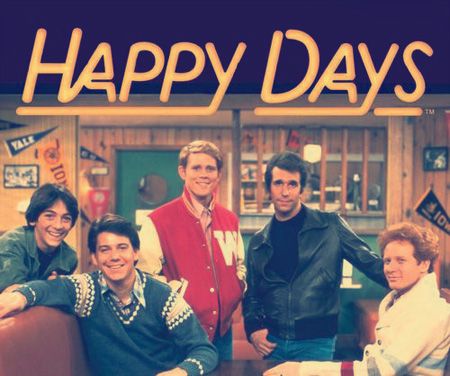
Small wonder that Happy Days became the No. 1 program on American TV in the mid-
1970s, becoming so popular that Henry Winkler, who played its breakout character
Fonzie (Arthur Fonzarella), was stopped on the street in Manhattan by an astonished
fan from England. “The Fonz!” said a starstruck Paul McCartney in greeting the actor.
In doing so, the coolest man of 1967 passed a metaphorical baton on a Lexington
Avenue sidewalk to the coolest man of 1977.
In much of the country the prevailing mood of the ’70s somehow remained “C’mon Get
Happy,” as expressed in the theme song for the hugely popular Partridge Family, who
drove their psychedelic painted school bus to their gigs, and whose young cast on TVs
rival show, The Brady Bunch, (Marsha, Marsha Marsha!) performed a hit of their own
called “Sunshine Day.”
Much of this nominal happiness in the so-called Me Decade—a phrase coined in a
seminal essay by author Tom Wolfe—was in the service of self-improvement and
ecological awakening. “The pursuit of happiness is a planet whose resources are
devoted to the physical and spiritual nourishment of its inhabitants,” said President
Jimmy Carter. And indeed, Carter’s own rise to the presidency from a peanut farm in
Plains, Georgia, represented a clean break from Richard Nixon and the endless scandal
of Watergate. Carter, elected in 1976, was caricatured for his oversize smile and his
bib-overalled brother, Billy, who flogged his own brand of beer – Billy Beer – and who
earned, by dint of $5,000 personal-appearance fees, more than the President did.
“Billy’s making so much money, he’s financing a pipeline to Milwaukee,” said Johnny
Carson, conjuring a beer pipeline to rival the newly opened Alaskan oil pipeline,
another controversial feat of the 1970s. Carson’s nightly monologue on The Tonight
Show gave buoyancy to the weighty news of the day, putting millions of Americans to
sleep with a smile.
And so, perhaps, did The Joy of Sex, which was published in 1972 and remained on
the New York Times best-seller list until 1974. It sold 12 million copies worldwide in a
decade that was slightly scandalous, and men were gold-chained, hairy-chested, permed, and
wide-lapeled.

In many ways, the ’70s aren’t preserved in amber so much
as entombed in a block of cheese – the decade didn’t take itself terribly seriously, and at
times it couldn’t take itself seriously, given its much-loved signature kitsch: lime-green
leisure suits, appliances in colors of avocado and harvest gold, the AMC Gremlin
subcompact car, shag carpeting, Pet Rocks, the Bermuda Triangle, the disaster
films of Irwin Allen (The Towering Inferno, The Poseidon Adventure, The Swarm),
Jell-O molds and casseroles, men wearing white belts with white loafers or white
3-piece suits like the one seemingly spray-painted onto John Travolta Saturday
Night Fever, or the white uniforms worn by the storm troopers in Star Wars. Think
of the Houston Oilers’ Billy (White Shoes) Johnson as he danced in the Astrodome end
zone on Monday Night Football; or the white outfits worn by the Hudson Brothers on
their Saturday morning kids’ show, The Hudson Brothers Razzle Dazzle Show; or the
white spikes worn by the Oakland A’s, who won three World Series and came to be
known as the Swingin’ A’s.
In the swingin’ ’70s, nothing swung harder than the Boeing 747, which made its maiden
voyage in January of 1970, and had a spiral staircase leading to an upstairs
lounge—often with a piano bar where transatlantic passengers could enjoy a Harvey
Wallbanger on their flight from New York to London.
As those travelers raised a highball at high altitude, consider that the ’70s were worth
celebrating in other ways, as well, because the biggest celebration of that decade was
devoted to the Bicentennial of our Nation, a party that peaked on the Fourth of July in
1976, with Presidential ceremonies, military flyovers, Declaration of Independence
historic reenactments, concerts, fireworks, tall ships in New York Harbor and LOTS of
parades—and Bicentennial mattress sales—on every Main Street. The Bicentennial
celebration lasted all year.
But the era was often tragic, too, and occasioned national reckoning, collective self-
examination, and mourning, especially as America began its slow extrication from
Vietnam and release and return of the many POWs/MIA from the war. Emerging from
the long shadows of war and Watergate, while enduring energy crises and
environmental horrors, people naturally embraced diversion and a kind of dogged
determination to be happy—or at least hopeful.
So there was Mary Tyler Moore throwing her hat into the sky in downtown Minneapolis
at the start of the show that bore her name, and whose theme song was “Love Is All
Around,” Edith and Archie Bunker of All In The Family “singing” together at the piano
“Those Were The Days”, Marlin Perkins’ Wild Kingdom and Eddie Albert and Eva
Gabor in Green Acres taking us on remote adventures, and Coca-Cola gathered young
people from various nations on a hill in Italy to sing “I’d like to buy the world a Coke,”
which became a pop hit for the Hillside Singers when retooled as “I’d Like to Teach the
World to Sing (In Perfect Harmony).” The ‘70s also endured the breakup of The
Beatles, softened a bit, to everyone’s relief, after each member’s individual stellar
contributions to the music world became just as loved, sung and revered.
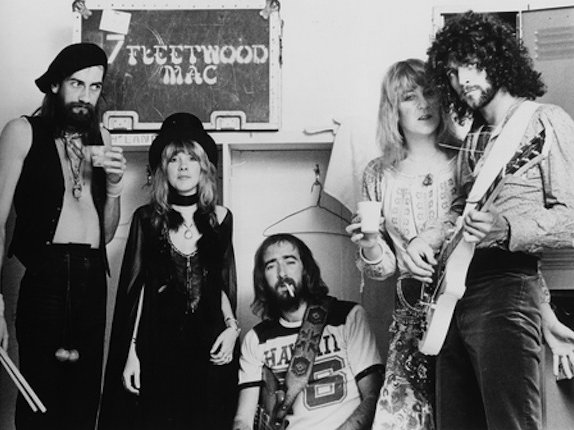
Other rock groups and performers of the ’70s, including Melanie, Fleetwood Mac, the
Eagles, The Band, Three Dog Night, Davie Bowie/Ziggy Stardust, Cat Stevens, Billy
Preston, Allman Brothers, Ike & Tina Turner, Steve Miller Band, Rod Stewart, CCR,
Neil Young, Blood Sweat & Tears, ELO, Don McLean, Joni Mitchell; Messina,
Carole King, James Taylor, Foghat, REO Speedwagon, Seals & Crofts, Roberta Flack,
Peter Frampton, and of course, Johnny Cash, James Brown, Aretha and Elvis, just to
name a few – sold zillions of albums in the heyday of the LP and 8-track, but they and
everything else in its path were eventually overtaken by cassette tapes and even more
formidably, disco, the strobe-light-illuminated, hip-gyrating music that pervaded the
culture from fashion to film (John Travolta in that white suit), and catalyzed the self-
indulgent party that was Studio 54 and it’s wannabes. An inevitable backlash ensued,
and the world was eventually inoculated itself against disco fever, so that by the time the
1980s arrived there was already a “what-were-we-thinking?!” hangover to the decade
just passed.
Still, the ’70s were vitally important, as every decade is, and shifted American culture, as
every decade does. It is easy to get lost in the ’70s, like a marble dropped into that shag
carpeting. Suspended between the countercultural revolution of the ’60s, and the fall of
communism in the ’80s, the ’70s were often portrayed as frivolous, surviving only as a
stage set that has been struck, loaded onto trucks, driven into posterity, and
remembered by its props: Pet Rocks, pull tab cans, Evel Knievel, rotary-dial phones
and giant Rolodexes, Bobby Sherman’s Love Beads, The Pacer, 10-speeds, Bundt
Cakes, bell bottoms, and Mikey of Life cereal fame, women wearing pale blue eye
shadow and platform shoes and Farah Faucet hair.
And yet, the decade contained all of life, for what is now history was once the present.
“These are the good old days,” as Carly Simon sang in 1972, in a song—“Anticipation”—
that would later be used to sell ketchup. “Thick, rich, Heinz ketchup,” declared American
Top 40 host Casey Kasem, whose rich, sing-songy voice provided the soundtrack for a decade
of youngsters who counted the minutes until the week’s Top 40 show aired on the radio
so they could win their $1 bets on who was #1 for the week.
The decade of the ‘70s continues to fascinate, resonate, deliver music to our ears and all facets of memories to those who witnessed it.



 Streamed yet?